


News
Rendezvous is a Wrap for 2018
Story by Marisue Potts with photos by Kayla White.
Like days of old, many different tribes, allies, and kinsmen gathered at Quitaque for a rendezvous on June 30, 2018, at the Comanchero Canyons Museum. This modern day gathering celebrated the colorful history of many cultures along the Caprock, that rugged escarpment that provided wood, shelter, and water and relief from the seemingly endless plains. While today’s tribes came from local villages of Briscoe, Swisher, Hall, Motley, and Floyd, outlanders dropped in from Lubbock, Plainview, Amarillo and more distant campsites in Oklahoma and even New York.
The Rendezvous or gathering is an annual fund raiser for the museum but also provides an opportunity to promote the history of the area and share the growing collections and exhibits ranging over the five Caprock counties of Briscoe, Swisher, Hall, Motley and Floyd. Approximately 175 people toured the museum and watched Cotton Elliott of Quitaque hammer out Indian-type bracelets; Vyrl Keeter of Muskogee, Oklahoma, flint-knapp arrow heads; Dr. Paul Katz identify artifacts and Rick Day identify fossils for collectors; and last, but not least, Henry Crawford of Lubbock who impersonates the Comanchero character that is the name sake of the museum.
Naming a Comanchero Canyons Museum Honoree of 2018 was a new feature of this year’s Rendezvous. The late Clyde Dudley was spotlighted by a display and video for his work as an educator, park interpreter, buffalo hunter reenactor, and civic leader. Dudley’s family attending included his wife Renee’ Dudley of Quitaque and their daughter, Lisa and husband Jimmy Kanetzky, Jonathan and Frances of College Station. Also enjoying the day were Mrs. Dudley’s sisters and families: Devorah and Melvin Justus of Slaton; Gwen and Eldon Martin and sons, Chuck and Kim Martin of Lubbock, and Kirk and Caren Martin of Syracuse, N.Y.
Comanchero Canyons Museum board members and workers cooked and served hamburgers; talked about exhibits, displays and history about the Comanches, Kiowas, and Comancheros; the Valley of Tears; the Texan Santa Fe Expedition of 1841; the Red River War of 1874; Charles Goodnight and the JA and F Ranches; and many other topics. The day was filled with renewing acquaintances with old friends and making new ones.
The museum is a grass-roots effort funded by local donations and some grants, including the CH Foundation of Lubbock and the Amarillo Foundation. Among the projects the volunteers have tackled include remodeling the donated building that was the former Church of Christ, on-going chores such as re-roofing, rewiring, and painting, reworking display cases, designing exhibits, creating videos and signage, building outdoor displays, and often giving up a Saturday to keep the museum open for visitors. Through collections, exhibits, and history, the museum has created kinship among the counties (our modern-day tribes) involved and broadened the circle of friendship as evidenced by The Rendezvous of 2018.
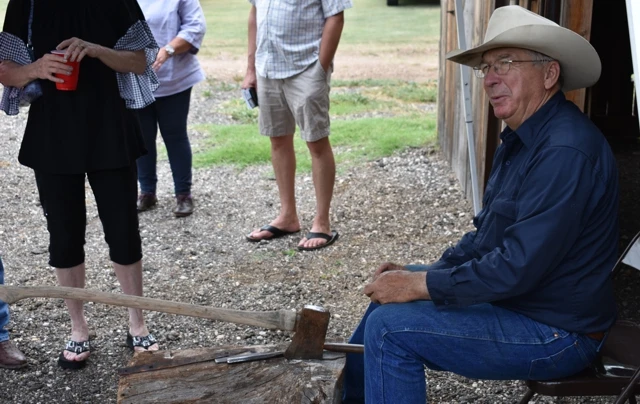
Local blacksmith Cotton Elliot demonstrated how the Native Americans may have made copper bracelets. Elliot used an old ax in place of an anvil.
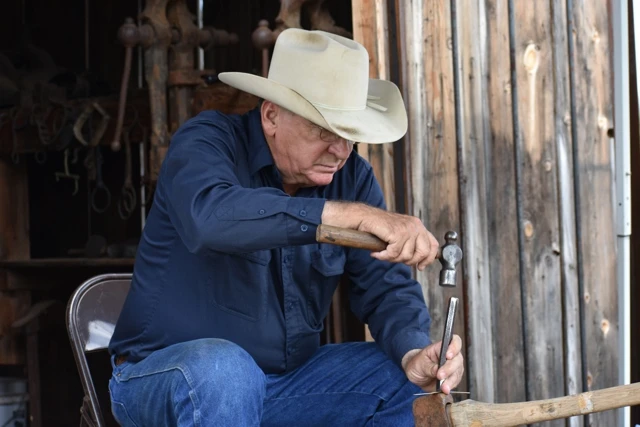
Blacksmith Cotton Elliot works on a copper bracelet.
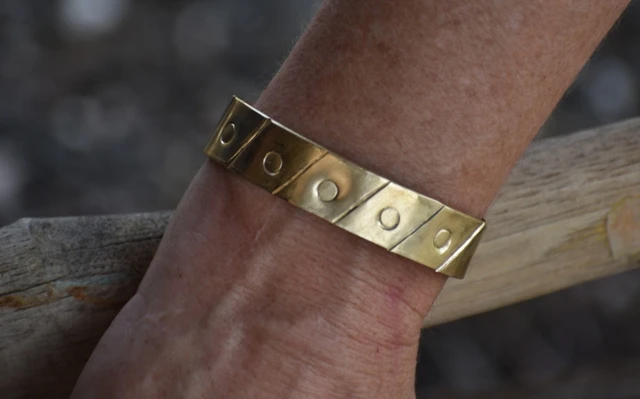
A brass bracelet made by Cotton Elliot.
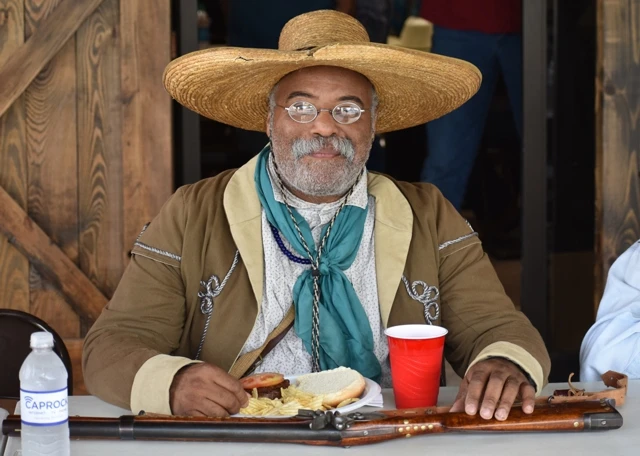
Comanchero with hamburger- (historical reenactor Henry Crawford).
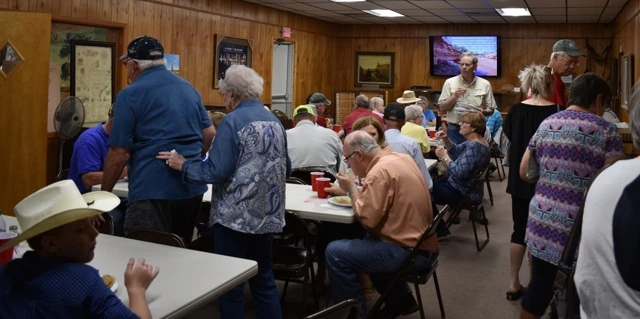
Lunchtime during the Rendezvous.
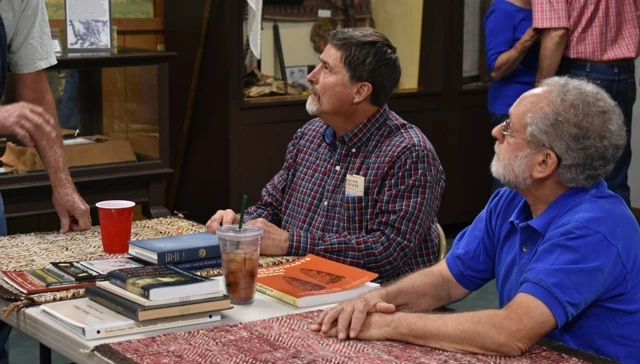
Archaeologists Rick Day and Paul Katz helped to identify artifacts that visitors brought in.
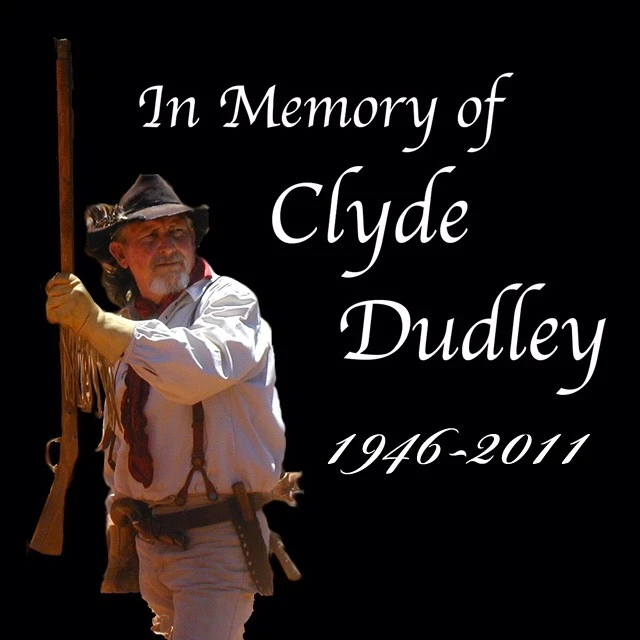
The 2018 honoree nominated by Comanchero Canyons Museum was the late Clyde Dudley. Dudley was honored at the Rendezvous, and his family was present.
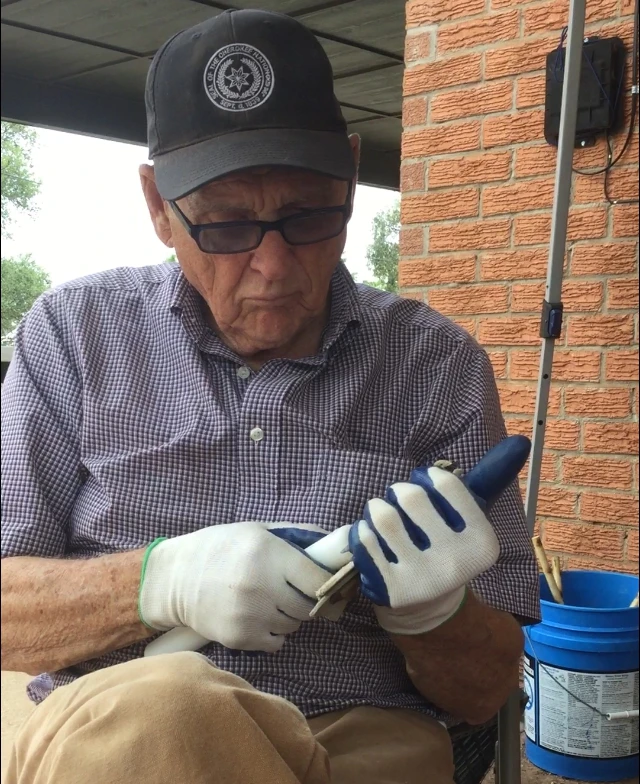
Flintknapper Vyrl Keeter working on an obsidian arrowpoint. Vyrl is from Muskogee, Oklahoma.
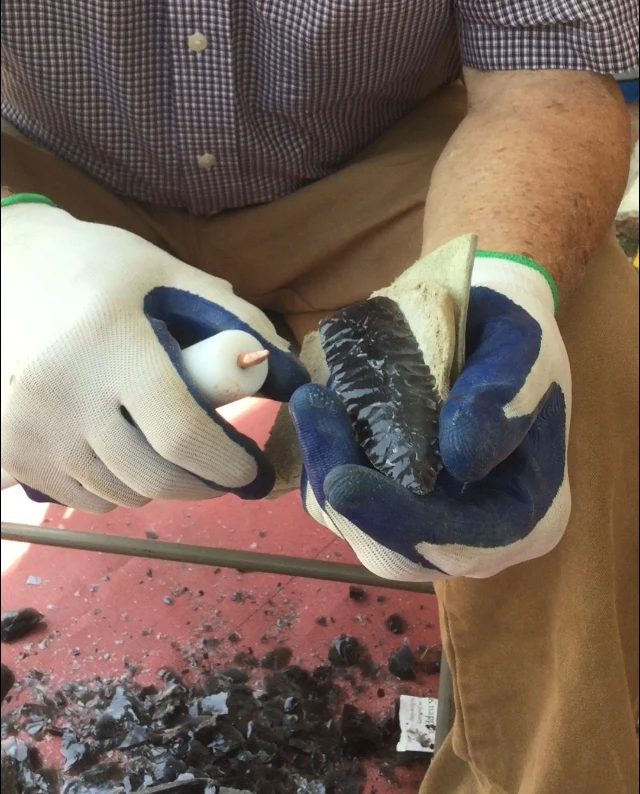
Making an obsidian arrowpoint.
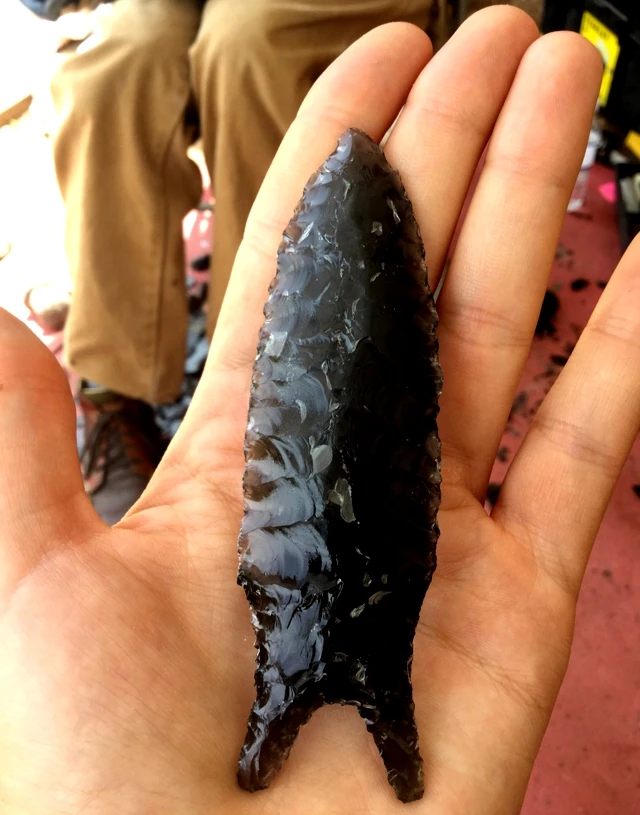
The finished obsidian arrowpoint made by flintknapper Vyrl Keeter.
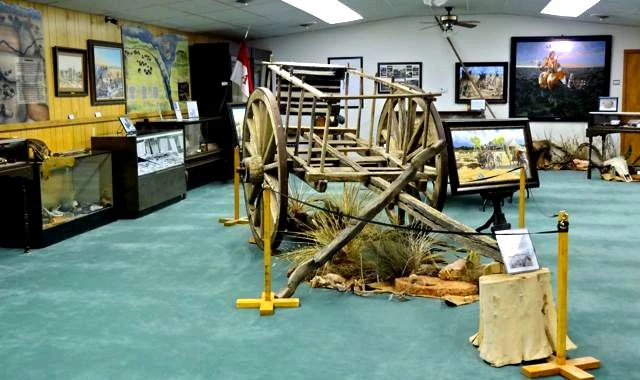
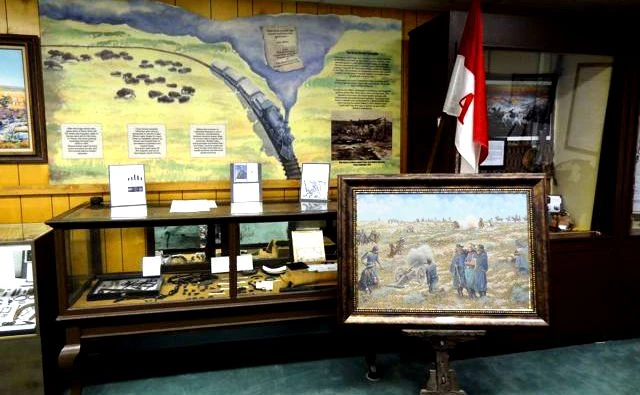
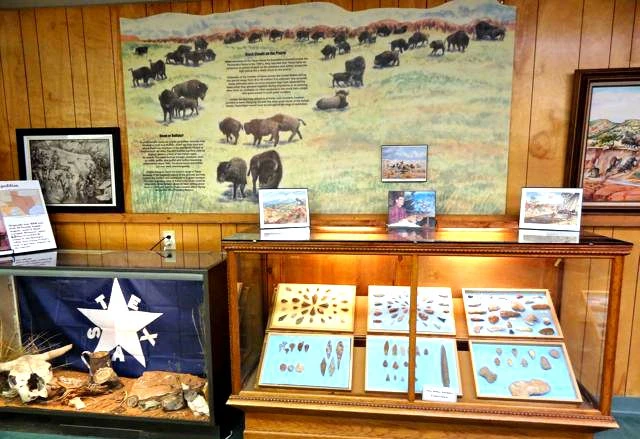
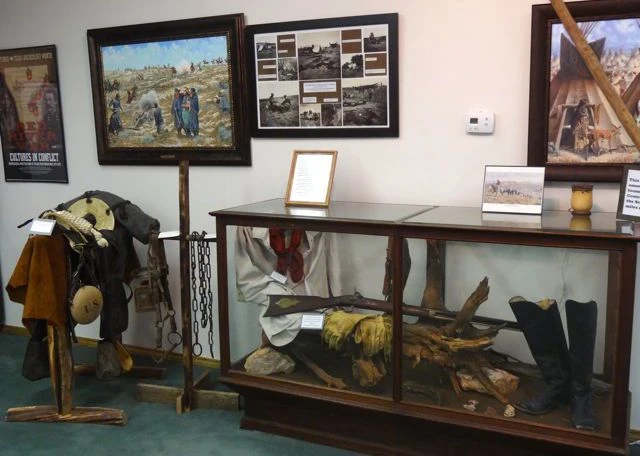
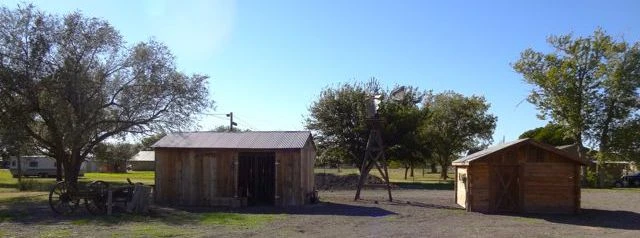
Log Cabin, Windmill, and Blacksmith Shop built and moved to museum grounds in 2016.
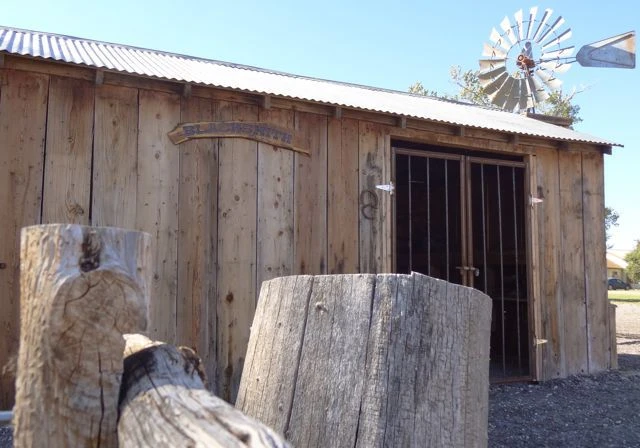
Blacksmith Shop
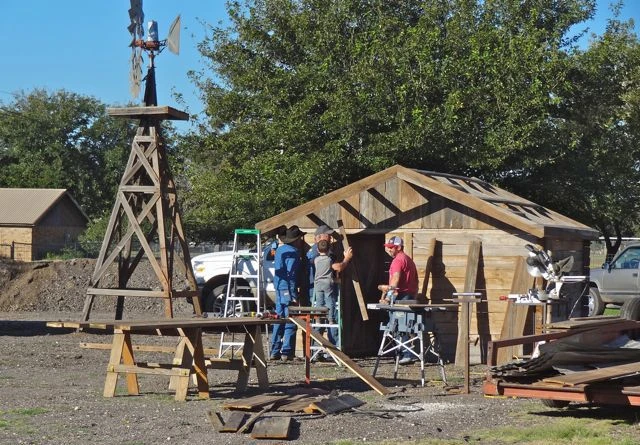
Log Cabin
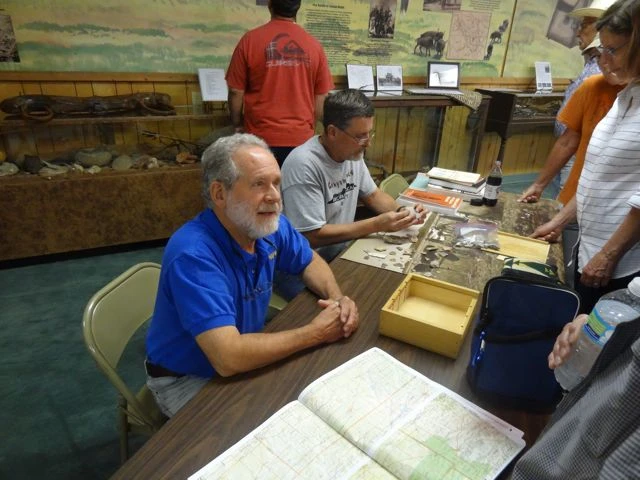
Experts Paul Katz and Rick Day discussing artifacts with visitors.
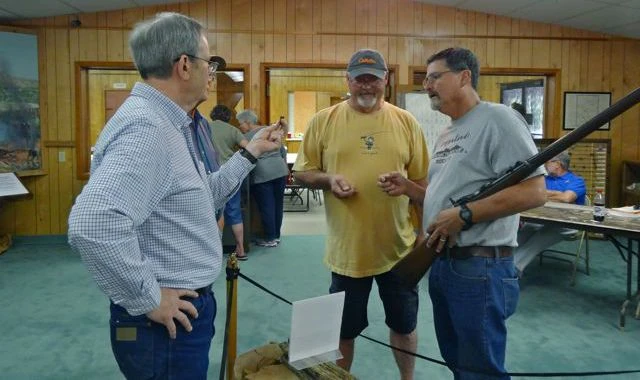
Jerry Leatherman, President of Comanchero Canyons Museum, discussing artifacts with visitors.
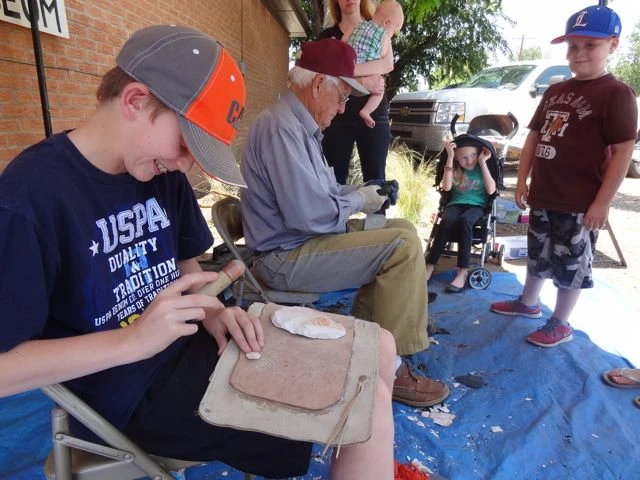
Flintknapper Vyrl Keeter with some young flintknappers
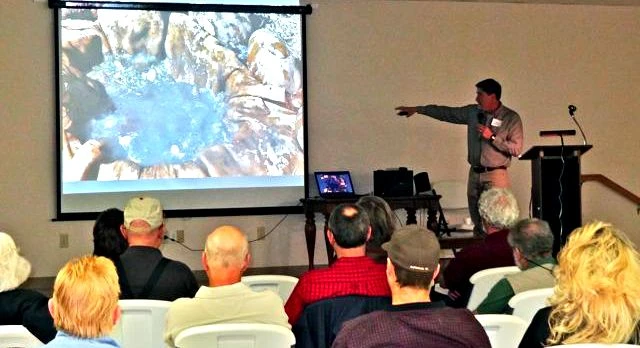
Speaker Rick Day, president of the Canyonlands Archaeological Society
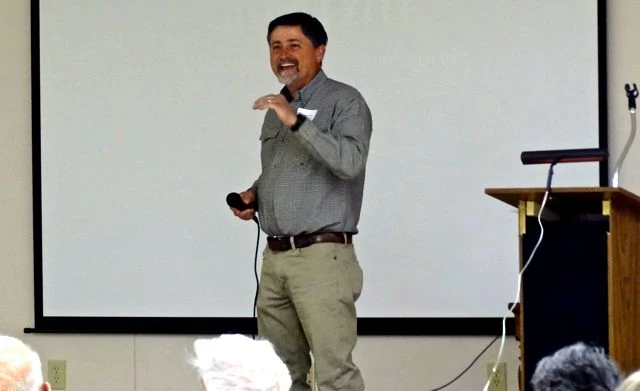
Speaker Rick Day, president of the Canyonlands Archaeological Society

Speaker Beryl Hughes from Panhandle Archaeological Society
Comanchero Canyons Museum Co-Hosted The Second West Texas Trails Meeting October 24, 2015
This article is reprinted from front page story in Caprock Courier by Carol Campbell.
You can blaze a trail, hit the trail, or follow tracks rather than a visible object. But one thing is certain, as long as man has walked upright on the earth; they have left trails for us to follow.
From explorer’s trails, cattle trails, rails to trail to asphalt trails – like the old Route 66 – trails are vast, they tell a story and “trails are interconnected,” event planner and past president of the West Texas Historical Association Marisue Potts said.
The “trails” initiative, the brainchild of Marisue Potts and Dr. Tai Kreidler, celebrated the 2nd anniversary meeting of West Texas Trails group in the beautiful Hope Center in Quitaque on October 24, 2015. About 60 registrants attended the conference, the formal organizing year for the group. Twenty charter members paid membership dues and marked their calendars for 2016.
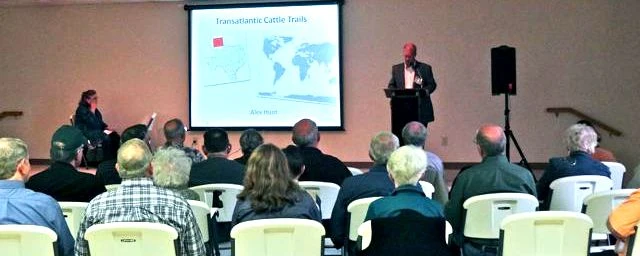
Keynote speaker Dr. Alex Hunt of West Texas A&M University examined the “concept of place”
and the influence of the foreign investors in Texas ranching in his speech entitled “Transatlantic Cattle Trails.”
Keynote speaker Dr. Alex Hunt examined the “concept of place” in his speech entitled “Transatlantic Cattle Trails.” Dr. Hunt has lived in the Great West from Fairbanks, Alaska, to West Texas but defining a place has always been elusive, he said. “Place has to do with motion, it was born of migration,” he said, adding, “Places are intersections of trails.”
He discussed the influence of the foreign investors in Texas ranching, where by 1882, English and Scottish capitol had invested more than $34 million in Western ranching. After the Comanche were subdued in the vast area of Texas and New Mexico known as the Comancheria, John Adair partnered with Charles Goodnight and founded the JA Ranch. Adair introduced British Hereford cattle to the Plains area. Cornelia Adair kept a diary in 1874 of her travels in the West that was published in 1918. He read excerpts from her diary where she made the observation that Americans had a “peculiar mobility” and an “extraordinary desire to travel” to forge new trails.
The Adair’s invested in the Plains, he said, as did Murdo Mackenzie, who founded the Matador Ranch, then sold to a Scottish Syndicate. Mackenzie founded a ranch in Brazil and recruited Panhandle cowboys to work the cattle. Cattle ranching became a “global enterprise,” he said, “So it is valuable to think about the trails that have opened up our regional history” and connected us to a place.
National Ranching Heritage Center’s Curator of Art and editor of the Ranch Record, Scott White, spoke on the “Trials of the Goodnight Trail”. The Goodnight-Loving trail was made popular in a television series “Lonesome Dove.” Goodnight met Oliver Loving after the Civil War, and in June 1866, Goodnight and Loving trailed 2,000 head of longhorn cattle with 16 cowhands to market in Ft. Sumner, NM, following the former route of the Butterfield Overland Mail. Charles Goodnight invented a traveling supply wagon, commonly known as the “chuckwagon” for this long trail drive. “Trail drives were done by the 1890s,” White said.
We learned the “Perils of Mapping Trails” and the changes of the “Great Western Trail Project” where Sylvia Mahoney (who was unable to attend) turned her program over to the capable hands of Dr. Tai Kreidler, Director of TTU Southwest Collection, Lubbock, who explained the difficulty of “terra incognita” where Coronado lost his bearings on the Staked Plains and wound up in Blanco Canyon. “Place names can change,” Kreidler said. Now, The Great Western Trail (GWT), a 19th century cattle trail that originated in northern Mexico, ran west parallel to the Chisholm Trails, and traversed the US for 2,000 miles, terminating on the Canadian border, is now being renamed without the “Great” by the National Park Service. Mahoney has marked the trail across Texas every six miles and a grass roots effort to verify the route has spread across nine US states, and into Saskatchewan, Canada. Mahoney didn’t act alone – Jeff Bearden and Mary Ann McCuiston and Rotarians in each local county helped mark the trail with cement markers, homemade by the McCuistons in their back yard, Marisue Potts added.
Following the morning session, guests lunched at the Tri-County Building, followed by an organizational meeting of the West Texas Trails group where Bob Saul, Fort Worth, was elected president and plans were made for the 3rd annual meeting in Mobeetie, TX, on the third weekend of October, 2016. A tour of the Comanchero Canyons Museum was attended by the group before starting afternoon sessions.
Following the introduction of Brian Gendron, a student intern at the Comanchero Canyons Museum and graduate student at Texas Tech University who said he was “Back Tracking the Trails: From Cody, Wyoming, to Quitaque,” we then explored the foot trails of the Llano Estacado with Shelley Armitage.
She returned from Santa Fe, NM, to a family farm in Vega after the death of her father and began “Walking the Llano,” a soon-to-be published book. She followed deer trails into the Little Alamosa Canyon. She showed beautiful slides of her trek into the canyon that empties into the Canadian River where she found remnants of stone pens and plazas. She said she “inherited the legacy of my father’s story” and followed the trail of a 16-year-old sheep herder, Ysabel Gurule from the Anton Chico sheep herding families. Gurule was one of the first settlers of the area, who her father had befriended.
“The Fort Worth and Denver Blasts Rail Trails Through the Caprock” was the title of Le’Ann Pigg’s presentation, an interpreter for Caprock Canyons State Park. Le’Ann skillfully took the audience with an image presentation down the Rails-to-Trails parkway to experience the challenges of laying rails to the top of the Caprock Escarpment, some 500- to 700 feet in elevation.
The railway served as a freight service from Estelline to South Plains, TX, about 64 miles, built by the Forth Worth and Denver Railroad. The railway was chartered in 1925 and by 1928 the FW&DRR had blasted two tunnels through the rugged canyons to meet the challenging feat of a 2-percent grade; laid an estimated 12 to 15 million pounds of sand and gravel for the bed; and placed 64 miles of rail. The rail line was closed in 1929. In the 1980s, the Rails-to-Trails parkway for hiking, biking, and equestrian travel was developed on the abandoned line.
When built, Clarity Tunnel was 700 feet long; it was shortened to 520 feet due to a derailment. The tunnel is listed on the National Register of Historical Places. Now, one-half million Mexican Freetail bats call the tunnel home from April through August. The Caprock Canyons State Park service conducts trail rides down the rail path.
Claude Hudspeth of San Angelo filled the slot of a presentation on “The Ozark Highway Promotional Trail” and spoke to the group on mapping the Overland Butterfield Trail in the remote regions of the West. One area so remote, he said, “if you’re running from the law, it’s a good place to go.”
Robert Hall spoke on “The Bankhead Highway,” a military solution proposed by US Senator John Bankhead in 1916, who proposed a highway system that ran from Washington DC to California. This asphalt trail helped build towns, increased commerce, and answered the need for the “mobile public” to travel. Trails come in all forms.
Dr. Holle Humphries spoke on “The Little Known Trail Into Palo Duro Canyon,” where seven companies of the 4th cavalry descended the trail in one hour by leading their horses single file down a 751 foot drop.
She introduced Armstrong County Museum board member Francis Ferris who presented her extensive research on the Battle of Palo Duro Canyon. Ferris lives in Wayside, TX, a small community on the south rim of Palo Duro Canyon.
Following the battle, where lodges were looted and burned and all winter food was destroyed, Col. Mackenzie captured 1,424 horses and drove them up the steep trail that troops had come down, Ferris said. The next day, after selecting horses to keep, 1,048 were caught and shot.
Following her presentation, Jim Brokenbek, a board member of the TPTR who spearheaded the placement of Quanah Parker arrows in Palmer and Randall counties, gave a short presentation on the placement of the granite marker at the Quanah Parker Arrow at the entrance of Palo Duro Canyon, where 100 descendants of Quanah Parker met in June, 2015, for a family reunion. A dedication ceremony was conducted by the descendants of Quanah Parker, including a Cedar Blessing Ceremony. He gave accounts of the appreciation of the Quanah Parker descendants on the work of the Quanah Parker Trail.
In the last presentation of the day, Dr. Barbara Brannon, Executive Director of the Texas Plains Trail, spoke on the creation of the 10 Heritage Trails in Texas, designed to “capture the geography, unique identity and symbiotic relationship between history and travel in the state.” Created in 2003, the trails program promoting heritage tourism in Texas, was not funded in the last legislative session, “putting the most effective tourism initiatives in Texas’ history in danger,” she said. She called for the West Texas Trails group to “tell your legislators to fund this program “that for every $1.00 Texas spends, heritage tourism returns $8.00 to state tax revenue.”
Wrapping up the conference, newly elected president of the West Texas Trails Association, Bob Saul, handed out Charter Membership cards to 20 members; a drawing was held for a miniature chuckwagon, courtesy of Robert Hall. The work of art was awarded to Ray Hopkins of Borger. In appreciation of her work on trails, Marisue Potts was given a miniature carata, courtesy of Robert Hall.
The group will meet next year in Mobeetie in Wheeler County, the 3rd weekend in October. For more information, contact Mr. Saul at [email protected]; or check out the new web site at westtexastrails.com.
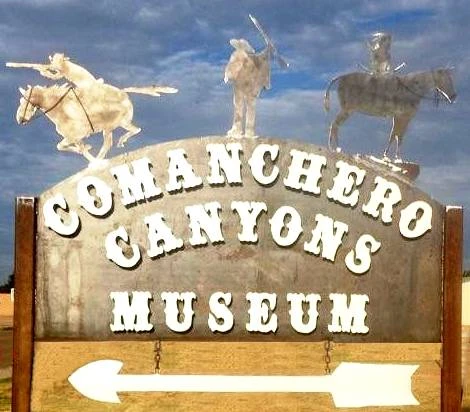
A prominent new sign pointing the way to Comanchero Canyons Museum in now in place on Highway 86 in Quitaque.
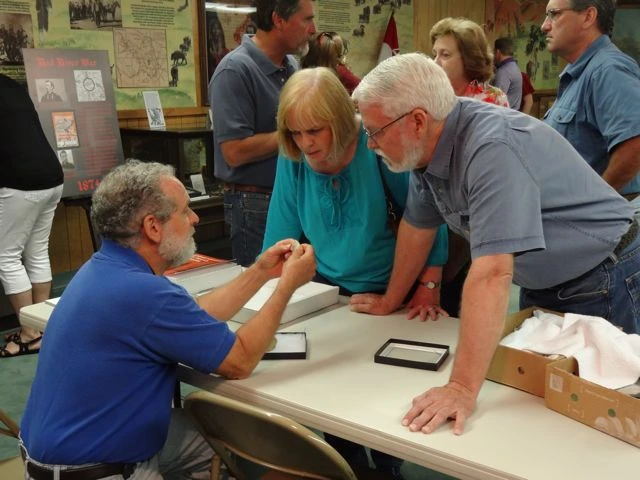
Archaeological expert Paul Katz examining visitor’s artifacts.
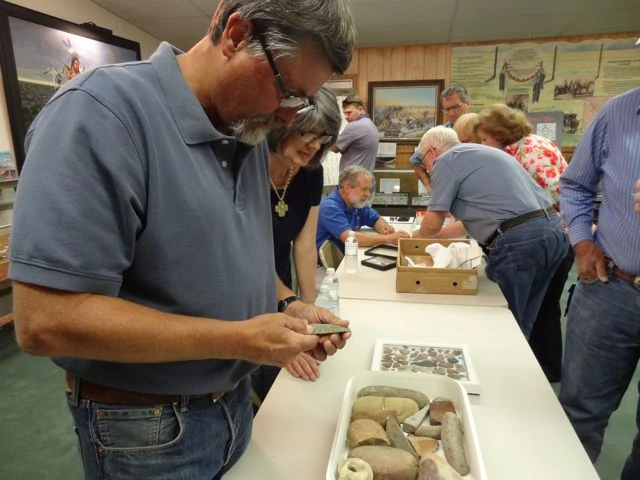
Expert Rick Day talking to visitors about an artifact.
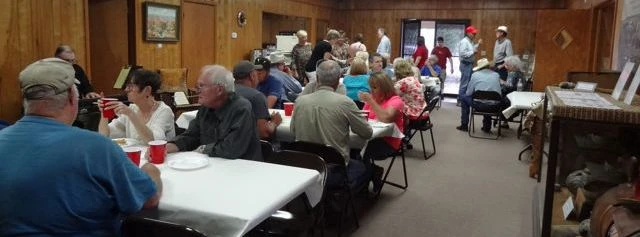
Lunch at Rendezvous 2015.